
📚 Documentation: https://zaoqu-liu.github.io/SCEVAN/
Overview
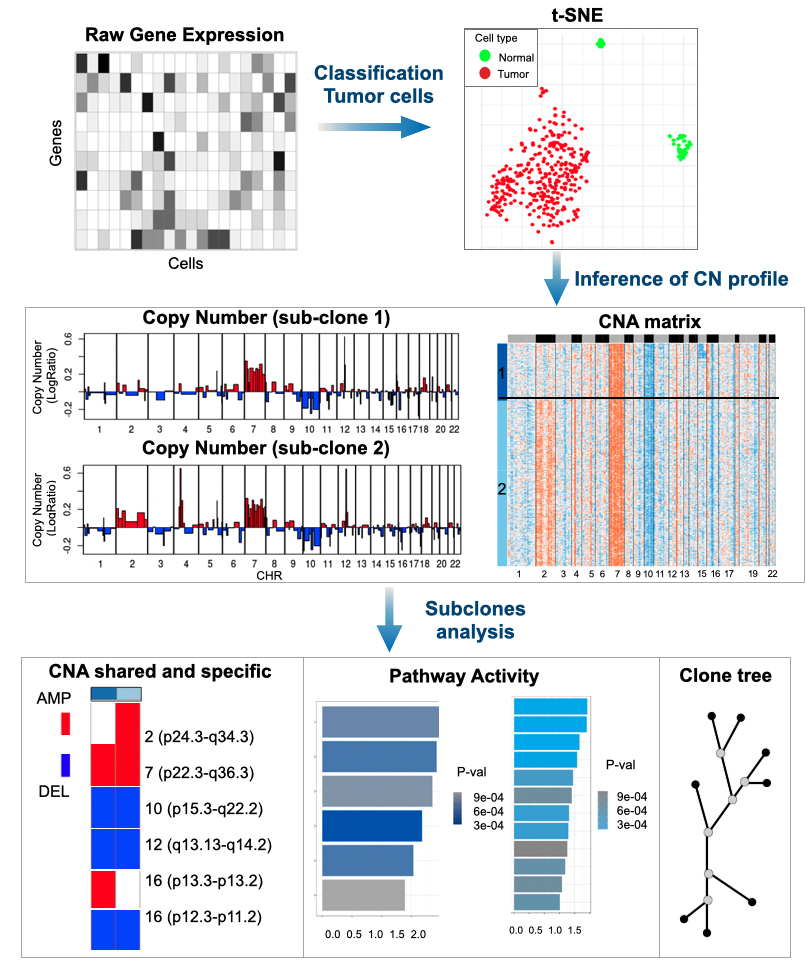
SCEVAN (Single CEll Variational Aneuploidy aNalysis) is a computational framework for automated tumor cell identification and copy number alteration (CNA) inference from single-cell RNA sequencing (scRNA-seq) data. The algorithm employs a variational segmentation approach combined with a hierarchical hidden Markov model to accurately delineate clonal copy number substructures within heterogeneous tumor populations.
Key Features
- Automated Cell Classification: Distinguishes malignant cells from non-malignant tumor microenvironment (TME) cells without prior knowledge
- Clonal Structure Inference: Identifies subclonal populations with distinct copy number architectures
- High Performance: Achieves F1 score of 0.90 across 106 samples (93,332 cells), outperforming state-of-the-art methods (F1 = 0.63)
- Computational Efficiency: Employs greedy multichannel segmentation for scalability to large datasets
- Cross-Platform Compatibility: Full support for Windows, macOS, and Linux
- Seurat Integration: Compatible with Seurat v4 and v5 workflows
Publication
De Falco, A., Caruso, F., Su, X.-D., Varone, A., & Ceccarelli, M. (2023). A variational algorithm to detect the clonal copy number substructure of tumors from scRNA-seq data. Nature Communications, 14, 1074.

Installation
From R-universe (Recommended)
install.packages("SCEVAN", repos = "https://zaoqu-liu.r-universe.dev")From GitHub
# Install dependencies
if (!requireNamespace("BiocManager", quietly = TRUE))
    install.packages("BiocManager")
BiocManager::install(c("EnsDb.Hsapiens.v86", "EnsDb.Mmusculus.v79", "scran", "fgsea"))

# Install yaGST dependency
remotes::install_github("miccec/yaGST")

# Install SCEVAN
remotes::install_github("Zaoqu-Liu/SCEVAN")
Quick Start
library(SCEVAN)

# Basic analysis with default parameters
results <- pipelineCNA(count_mtx, sample = "sample_name")
Usage
Single-Sample Analysis
The pipelineCNA() function performs the complete analysis pipeline including cell classification and clonal structure characterization.
results <- pipelineCNA(
  count_mtx,                    # Raw count matrix (genes × cells)
  sample = "sample_name",       # Sample identifier
  par_cores = 20,               # Number of parallel cores
  organism = "human",           # "human" or "mouse"
  SUBCLONES = TRUE,             # Enable subclone detection
  beta_vega = 0.5,              # Segmentation granularity parameter
  ClonalCN = TRUE,              # Infer clonal CN profile
  plotTree = FALSE              # Plot phylogenetic tree
)
Parameters
| Parameter | Description | Default |
|---|---|---|
count_mtx |
Raw count matrix with genes on rows and cells on columns | Required |
sample |
Sample name for output files | "" |
par_cores |
Number of parallel cores | 20 |
norm_cell |
Known normal cells for reference | NULL |
SUBCLONES |
Enable subclonal analysis | TRUE |
beta_vega |
Segmentation parameter (higher = coarser) | 0.5 |
ClonalCN |
Infer clonal CN profile | TRUE |
plotTree |
Generate phylogenetic tree plot | FALSE |
organism |
Species ("human" or "mouse") |
"human" |
FIXED_NORMAL_CELLS |
Use provided normal cells as fixed reference | FALSE |
Multi-Sample Comparison
For comparative analysis across multiple samples:
multiSampleComparisonClonalCN(
  listCountMtx,                 # Named list of count matrices
  listNormCells = NULL,         # List of normal cells per sample
  analysisName = "comparison",  # Analysis identifier
  organism = "human",
  par_cores = 20
)
Seurat Integration
SCEVAN integrates seamlessly with Seurat workflows:
# Run SCEVAN analysis
results <- pipelineCNA(count_mtx)

# Add to existing Seurat object
seurat_obj <- Seurat::AddMetaData(seurat_obj, metadata = results)

# Or create new Seurat object with SCEVAN annotations
seurat_obj <- Seurat::CreateSeuratObject(count_mtx, meta.data = results)
Extract Count Matrix from Seurat Object
# Compatible with Seurat v4 and v5
count_mtx <- getCountMtxFromSeurat(seurat_obj, assay = "RNA")
Visualizing Region-Specific CNAs
# Load analysis outputs
load("output/sample_count_mtx_annot.RData")
load("output/sample_CNAmtx.RData")

# Extract CN ratio for specific genomic region
region_cn <- apply(
  CNA_mtx_relat[count_mtx_annot$seqnames == 3 &
                count_mtx_annot$start >= 158644278 &
                count_mtx_annot$end <= 194498364, ],
  2, mean
)

# Visualize with Seurat
seurat_obj <- AddMetaData(seurat_obj, region_cn, col.name = "chr3_cn")
FeaturePlot(seurat_obj, "chr3_cn", cols = c("gray", "red"))
CNA Heatmap with Annotations
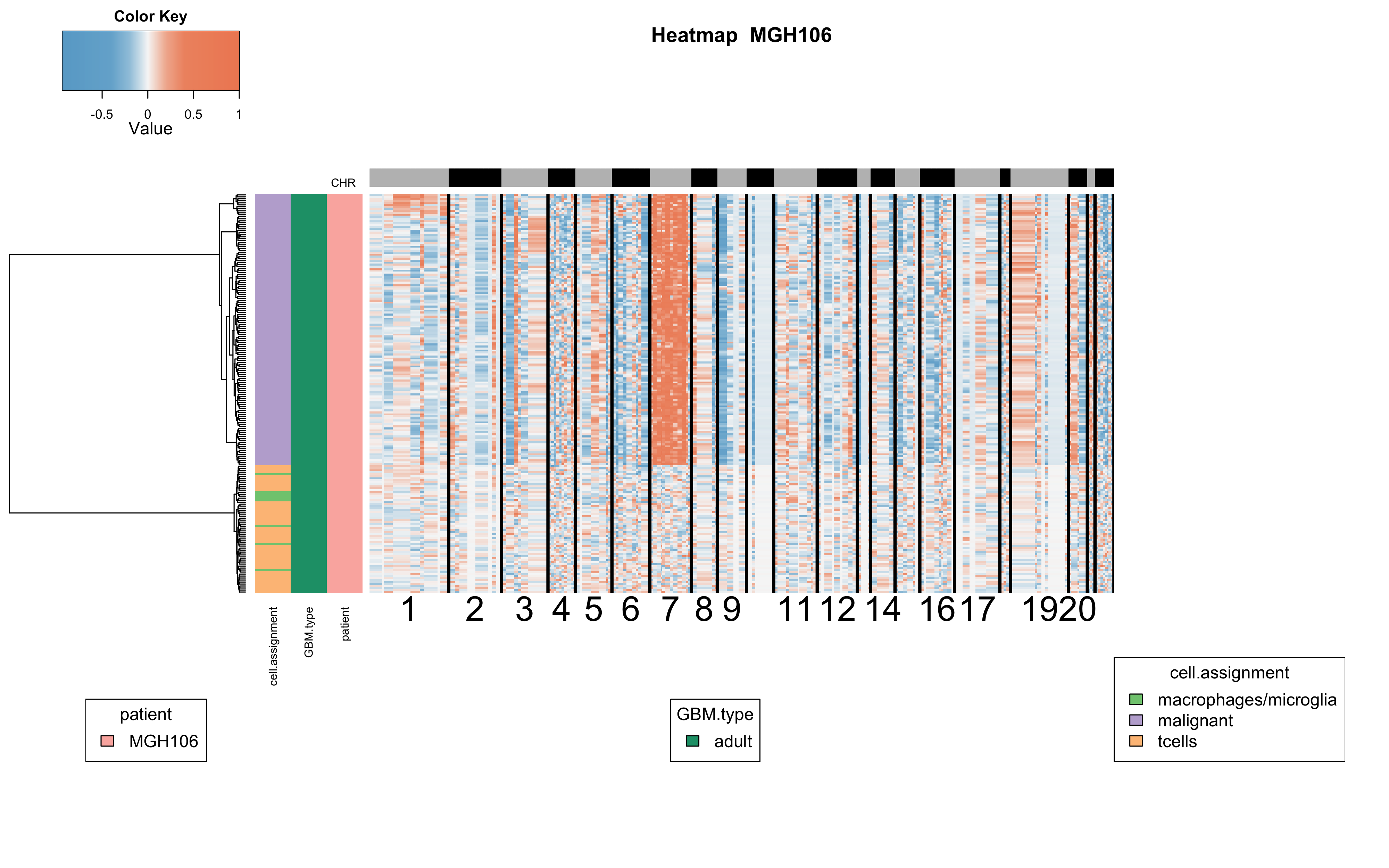
Generate annotated CNA heatmaps incorporating cell metadata:
plotCNA_withAnnotCells(
  SampleName = "sample_name",
  metadata = cell_annotations,      # data.frame with cell annotations
  COLUMNS_TO_PLOT = c("cell_type", "cluster"),
  SUBCLONE = TRUE                   # Plot subclone-specific profiles
)
Vignettes
Detailed tutorials demonstrating SCEVAN functionality:
- Intratumoral Heterogeneity Analysis - Glioblastoma case study
- Two-Sample Comparison - Head and neck cancer
- Multi-Sample Analysis - Three-sample comparison
Example Datasets
Pre-processed datasets for testing and tutorials:
| Dataset | Description | Download |
|---|---|---|
| MGH106 | Glioblastoma (GSE131928) | Download |
| listCountMtx | MGH102/104/105/106 combined | Download |
| HNSCC26 | Head & Neck Cancer (GSE10332) | Download |
Citation
If you use SCEVAN in your research, please cite:
@article{DeFalco2023,
  author  = {De Falco, Antonio and Caruso, Francesca and Su, Xiao-Dong and
             Varone, Antonio and Ceccarelli, Michele},
  title   = {A variational algorithm to detect the clonal copy number
             substructure of tumors from scRNA-seq data},
  journal = {Nature Communications},
  year    = {2023},
  volume  = {14},
  pages   = {1074},
  doi     = {10.1038/s41467-023-36790-9}
}
License
This project is licensed under the GPL-2 License - see the LICENSE file for details.
Contact
- Maintainer: Zaoqu Liu (liuzaoqu@163.com)
- Issues: GitHub Issues
- Repository: https://github.com/Zaoqu-Liu/SCEVAN