Algorithm and Statistical Methods
Zaoqu Liu
2026-01-23
Source:vignettes/algorithm.Rmd
algorithm.RmdOverview
This vignette describes the statistical methods and algorithms implemented in iTALK for intercellular communication analysis.
Ligand-Receptor Database
Database Structure
iTALK includes a curated database of 2,649 ligand-receptor pairs categorized into four functional groups:
Database Sources
The database integrates information from:
- Cytokines - Zhang et al., 2007; Cameron et al., 2000-2013
- Checkpoint molecules - Auslander et al., 2018
- Ligand-receptor pairs - Ramilowski et al., Nature Communications, 2015
# Database columns
cat("Database columns:", paste(colnames(db), collapse = ", "), "\n\n")
#> Database columns: Pair.Name, Ligand.ApprovedSymbol, Ligand.Name, Receptor.ApprovedSymbol, Receptor.Name, Classification

# Example entries
head(db[, c("Ligand.ApprovedSymbol", "Receptor.ApprovedSymbol", "Classification")])
#>   Ligand.ApprovedSymbol Receptor.ApprovedSymbol Classification
#> 1                   A2M                    LRP1          other
#> 2                 AANAT                  MTNR1A          other
#> 3                 AANAT                  MTNR1B          other
#> 4                   ACE                   AGTR2          other
#> 5                   ACE                  BDKRB2          other
#> 6                ADAM10                     AXL          other
Statistical Methods for Differential Expression
Method Comparison
iTALK supports seven statistical methods for identifying differentially expressed genes:
| Method | Model | Best For | Reference |
|---|---|---|---|
| Wilcox | Wilcoxon rank-sum | General purpose | - |
| DESeq2 | Negative binomial | Bulk RNA-seq | Love et al., 2014 |
| edgeR | Negative binomial + EB | Bulk RNA-seq | McCarthy et al., 2012 |
| MAST | Two-part hurdle | scRNA-seq | Finak et al., 2015 |
| monocle | Census-based | Trajectory analysis | Qiu et al., 2017 |
| SCDE | Bayesian | scRNA-seq | Kharchenko et al., 2014 |
| DEsingle | Zero-inflated NB | Dropout modeling | Miao et al., 2018 |
Wilcoxon Rank-Sum Test
The default method uses the Wilcoxon rank-sum test (Mann-Whitney U test):
Where is the rank of observation in the combined sample.
Log Fold Change Calculation:
For raw counts:
Where prevents division by zero.
For log-transformed data:
L-R Pair Detection Algorithm
Workflow
┌─────────────────┐
│  Gene List(s)   │
│  (expr/DEG)     │
└────────┬────────┘
         │
         ▼
┌─────────────────┐
│ Species Check   │──► Auto-conversion if needed
└────────┬────────┘
         │
         ▼
┌─────────────────┐
│ Database Match  │
│ Ligand ∩ Recep  │
└────────┬────────┘
         │
         ▼
┌─────────────────┐
│ Annotate Pairs  │
│ + Cell Types    │
└────────┬────────┘
         │
         ▼
┌─────────────────┐
│ Filter & Output │
└─────────────────┘
Matching Algorithm
For “mean count” datatype:
# Pseudocode
ligand_genes <- intersect(input_genes, database$Ligand)
receptor_genes <- intersect(input_genes, database$Receptor)
pairs <- database[database$Ligand %in% ligand_genes &
                  database$Receptor %in% receptor_genes, ]
For “DEG” datatype, additional filtering removes pairs where both ligand and receptor are not differentially expressed (logFC = 0.0001 placeholder).
Multiple Testing Correction
All p-values are adjusted using the Benjamini-Hochberg procedure:
Where: - = i-th smallest p-value - = total number of tests - = adjusted p-value (FDR)
# Demonstration of BH correction
set.seed(42)
p_values <- c(runif(50, 0, 0.01), runif(50, 0.01, 1))  # Mix of significant and non-significant

q_values <- p.adjust(p_values, method = "BH")

# Visualize
par(mfrow = c(1, 2))
hist(p_values, breaks = 20, main = "Raw P-values", xlab = "P-value", col = "steelblue")
hist(q_values, breaks = 20, main = "BH-adjusted Q-values", xlab = "Q-value", col = "coral")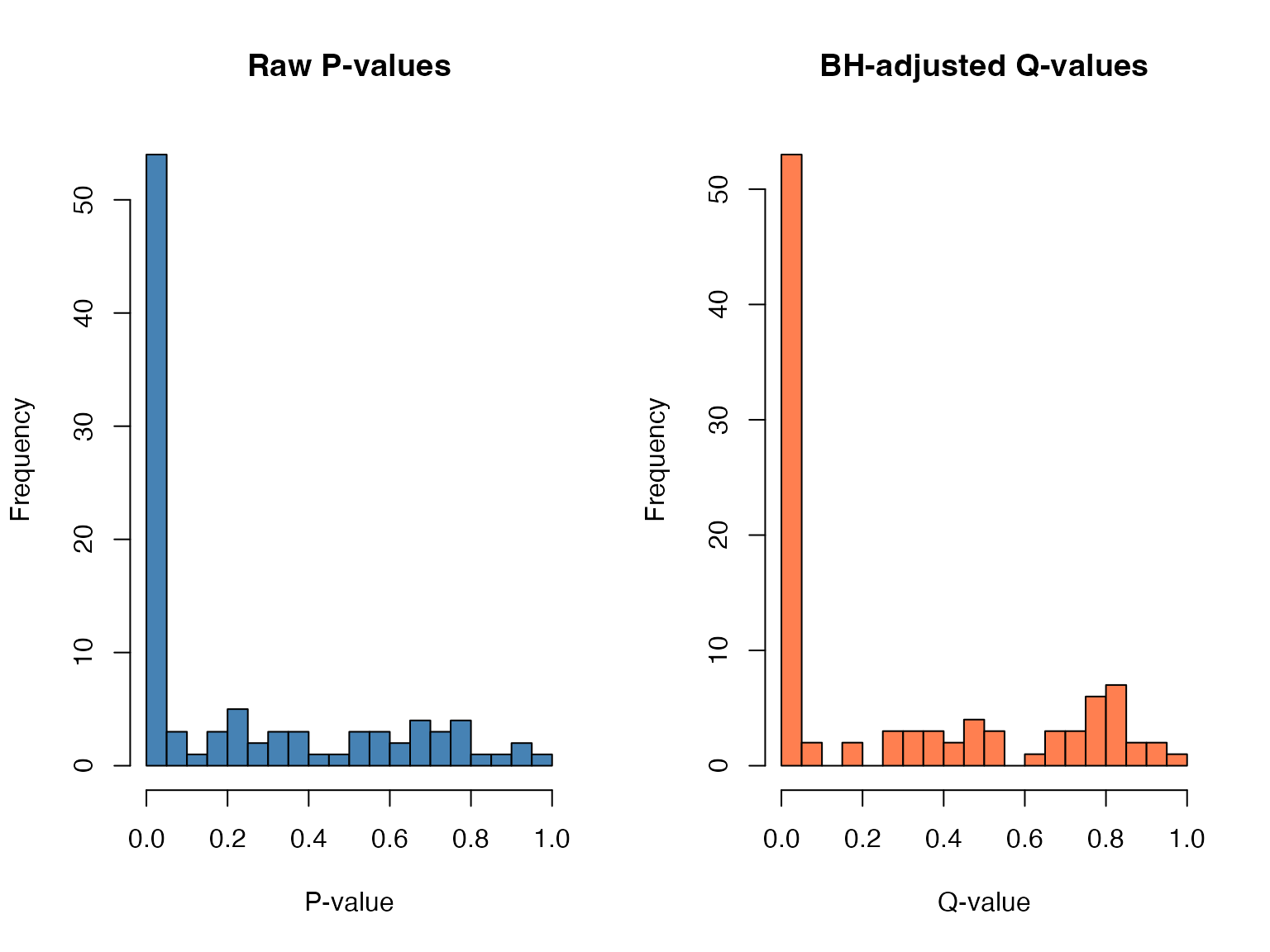
Communication Strength Metrics
Network Construction
Cell-cell communication networks are constructed using:
- Nodes = Cell types
- Edges = Number of L-R pairs between cell types
- Edge weights = Communication frequency or strength
library(igraph)

# Example network construction
edges <- data.frame(
  from = c("T_cell", "T_cell", "Macrophage", "Dendritic"),
  to = c("Macrophage", "B_cell", "T_cell", "T_cell"),
  weight = c(15, 8, 12, 6)
)

g <- graph_from_data_frame(edges, directed = TRUE)
E(g)$width <- E(g)$weight / 3

plot(g,
     vertex.size = 30,
     vertex.color = "lightblue",
     edge.arrow.size = 0.5,
     main = "Cell Communication Network")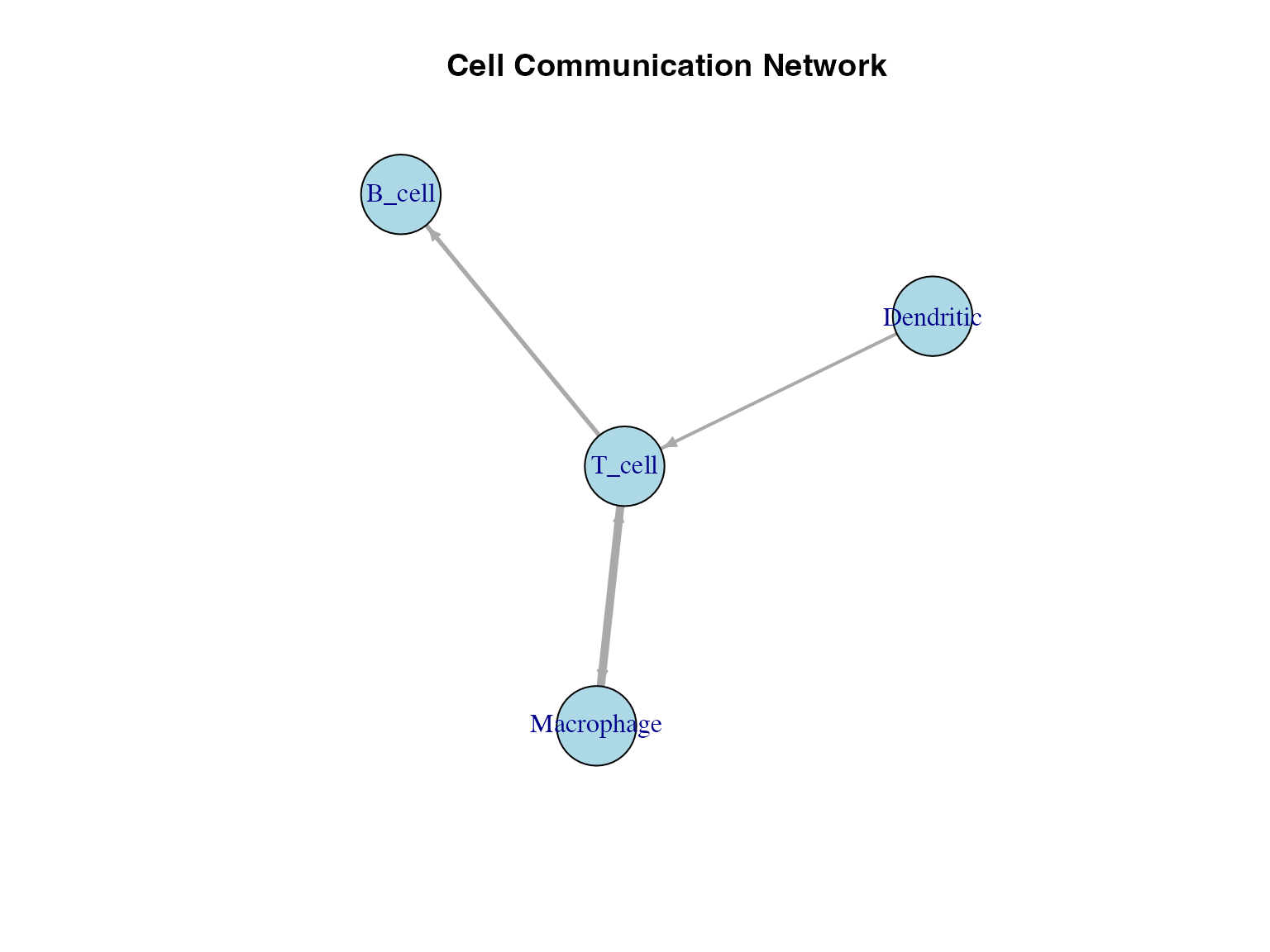
Computational Complexity
| Operation | Time Complexity | Space Complexity |
|---|---|---|
| rawParse | O(n × g) | O(c × g) |
| FindLR | O(g × d) | O(p) |
| DEG (Wilcox) | O(n × g) | O(g) |
| LRPlot | O(p) | O(p) |
| NetView | O(c²) | O(c²) |
Where: - n = number of cells - g = number of genes - c = number of cell types - d = database size - p = number of pairs
References
Love MI, Huber W, Anders S. Moderated estimation of fold change and dispersion for RNA-seq data with DESeq2. Genome Biology. 2014;15:550.
Finak G, et al. MAST: a flexible statistical framework for assessing transcriptional changes and characterizing heterogeneity in single-cell RNA sequencing data. Genome Biology. 2015;16:278.
Wang Y, et al. iTALK: an R Package to Characterize and Illustrate Intercellular Communication. bioRxiv. 2019;507871.
Session Info
sessionInfo()
#> R version 4.4.0 (2024-04-24)
#> Platform: aarch64-apple-darwin20
#> Running under: macOS 15.6.1
#>
#> Matrix products: default
#> BLAS:   /Library/Frameworks/R.framework/Versions/4.4-arm64/Resources/lib/libRblas.0.dylib
#> LAPACK: /Library/Frameworks/R.framework/Versions/4.4-arm64/Resources/lib/libRlapack.dylib;  LAPACK version 3.12.0
#>
#> locale:
#> [1] C
#>
#> time zone: Asia/Shanghai
#> tzcode source: internal
#>
#> attached base packages:
#> [1] stats     graphics  grDevices utils     datasets  methods   base
#>
#> other attached packages:
#> [1] igraph_2.2.1 iTALK_0.1.1
#>
#> loaded via a namespace (and not attached):
#>   [1] RColorBrewer_1.1-3          RcppArmadillo_15.2.3-1
#>   [3] jsonlite_2.0.0              shape_1.4.6.1
#>   [5] magrittr_2.0.4              modeltools_0.2-24
#>   [7] farver_2.1.2                rmarkdown_2.30
#>   [9] GlobalOptions_0.1.3         fs_1.6.6
#>  [11] zlibbioc_1.52.0             ragg_1.5.0
#>  [13] vctrs_0.7.0                 Cairo_1.7-0
#>  [15] fastICA_1.2-7               scde_2.34.0
#>  [17] progress_1.2.3              htmltools_0.5.9
#>  [19] S4Arrays_1.6.0              curl_7.0.0
#>  [21] SparseArray_1.6.2           sass_0.4.10
#>  [23] bslib_0.9.0                 HSMMSingleCell_1.26.0
#>  [25] htmlwidgets_1.6.4           desc_1.4.3
#>  [27] plyr_1.8.9                  sandwich_3.1-1
#>  [29] zoo_1.8-15                  cachem_1.1.0
#>  [31] lifecycle_1.0.5             pkgconfig_2.0.3
#>  [33] Matrix_1.7-4                R6_2.6.1
#>  [35] fastmap_1.2.0               GenomeInfoDbData_1.2.13
#>  [37] MatrixGenerics_1.18.1       digest_0.6.39
#>  [39] numDeriv_2016.8-1.1         pcaMethods_1.98.0
#>  [41] colorspace_2.1-2            miscTools_0.6-28
#>  [43] S4Vectors_0.44.0            DESeq2_1.46.0
#>  [45] irlba_2.3.5.1               textshaping_1.0.4
#>  [47] GenomicRanges_1.58.0        extRemes_2.2-1
#>  [49] RMTstat_0.3.1               mgcv_1.9-3
#>  [51] httr_1.4.7                  abind_1.4-8
#>  [53] compiler_4.4.0              brew_1.0-10
#>  [55] S7_0.2.1                    BiocParallel_1.40.2
#>  [57] viridis_0.6.5               MASS_7.3-65
#>  [59] quantreg_6.1                MAST_1.32.0
#>  [61] DelayedArray_0.32.0         rjson_0.2.23
#>  [63] tools_4.4.0                 otel_0.2.0
#>  [65] DDRTree_0.1.5               nnet_7.3-20
#>  [67] glue_1.8.0                  nlme_3.1-168
#>  [69] grid_4.4.0                  Rtsne_0.17
#>  [71] cluster_2.1.8.1             reshape2_1.4.5
#>  [73] generics_0.1.4              gtable_0.3.6
#>  [75] monocle_2.34.0              tidyr_1.3.2
#>  [77] hms_1.1.4                   data.table_1.18.0
#>  [79] flexmix_2.3-20              XVector_0.46.0
#>  [81] BiocGenerics_0.52.0         RANN_2.6.2
#>  [83] pillar_1.11.1               stringr_1.6.0
#>  [85] Lmoments_1.3-2              limma_3.62.2
#>  [87] circlize_0.4.17             splines_4.4.0
#>  [89] dplyr_1.1.4                 Rook_1.2
#>  [91] lattice_0.22-7              survival_3.8-3
#>  [93] SparseM_1.84-2              gamlss.data_6.0-7
#>  [95] tidyselect_1.2.1            SingleCellExperiment_1.28.1
#>  [97] locfit_1.5-9.12             pbapply_1.7-4
#>  [99] randomcoloR_1.1.0.1         knitr_1.51
#> [101] gridExtra_2.3               V8_8.0.1
#> [103] IRanges_2.40.1              edgeR_4.4.2
#> [105] SummarizedExperiment_1.36.0 stats4_4.4.0
#> [107] xfun_0.56                   Biobase_2.66.0
#> [109] statmod_1.5.1               matrixStats_1.5.0
#> [111] pheatmap_1.0.13             leidenbase_0.1.36
#> [113] stringi_1.8.7               VGAM_1.1-14
#> [115] UCSC.utils_1.2.0            statnet.common_4.13.0
#> [117] yaml_2.3.12                 evaluate_1.0.5
#> [119] codetools_0.2-20            bbmle_1.0.25.1
#> [121] DEsingle_1.26.0             tibble_3.3.1
#> [123] cli_3.6.5                   systemfonts_1.3.1
#> [125] jquerylib_0.1.4             network_1.19.0
#> [127] dichromat_2.0-0.1           pscl_1.5.9
#> [129] Rcpp_1.1.1                  GenomeInfoDb_1.42.3
#> [131] coda_0.19-4.1               bdsmatrix_1.3-7
#> [133] parallel_4.4.0              MatrixModels_0.5-4
#> [135] pkgdown_2.1.3               ggplot2_4.0.1
#> [137] prettyunits_1.2.0           gamlss.dist_6.1-1
#> [139] viridisLite_0.4.2           mvtnorm_1.3-3
#> [141] slam_0.1-55                 scales_1.4.0
#> [143] gamlss_5.5-0                purrr_1.2.1
#> [145] crayon_1.5.3                combinat_0.0-8
#> [147] distillery_1.2-2            maxLik_1.5-2.1
#> [149] rlang_1.1.7